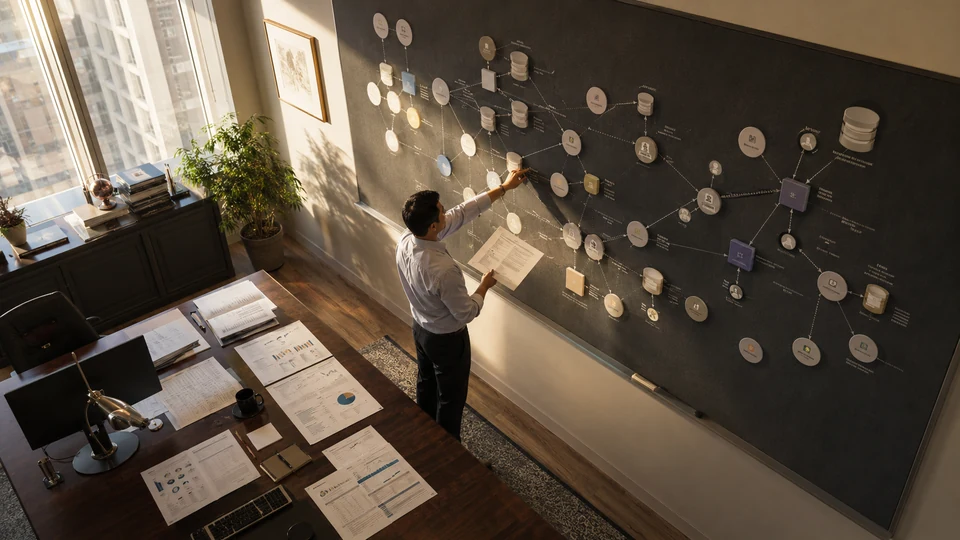
Assessment must adapt to ubiquitous AI
When general-purpose AI is readily available outside institutional control, take-home output alone becomes weaker evidence of individual capability. Assessment will shift toward process, oral defence and authentic performance.
 FUURAA original conceptual visual
What the evidence indicates
The Core Argument of “OECD Digital Education Outlook 2026”
When general-purpose AI is readily available outside institutional control, take-home output alone becomes weaker evidence of individual capability. Assessment will shift toward process, oral defence and authentic performance.
FUURAA Editorial Analysis
Reading “OECD Digital Education Outlook 2026”: How Should Assessment Adapt When AI Is Ubiquitous?
Ubiquitous generative AI does not make assessment impossible; it makes hidden assumptions about authorship, access and competence impossible to ignore. Education systems need to decide when AI use is part of the capability being assessed and when unassisted performance remains essential. The answer is a portfolio of complementary evidence, not a single detector, surveillance system or return to one examination format.
The Core Argument of “OECD Digital Education Outlook 2026”
The Outlook links generative AI to a long-standing assessment problem: a submitted product may not reveal how it was produced or what the learner can independently do. Easy access to fluent generation intensifies that gap. Traditional take-home work can still support learning, but it becomes weaker as sole evidence of individual mastery when assistance is undeclared or unlimited. At the same time, banning AI from every assessment would misrepresent domains in which professionals are expected to use tools responsibly. The report supports adaptation around educational purpose rather than a universal prohibition. It does not independently verify the reliability of AI detectors, remote proctoring or any specific redesign, and its emerging evidence does not justify treating all students as suspected misconduct cases.
First define the construct, then define permitted assistance
An assessment is valid only if it measures the capability it claims to measure. If the target is unaided recall, foundational calculation or spontaneous oral communication, AI assistance changes the construct and should be restricted. If the target is research synthesis, software development or professional drafting, competent tool use, source checking and revision may belong inside the construct. Institutions should state the target before choosing controls. A useful assessment brief names permitted tools, required disclosure, protected data, source expectations and the learner decisions that must remain visible. This reduces ambiguity and makes integrity teachable. It also prevents a weak shortcut in which institutions keep old tasks unchanged and add detection technology after the fact.
Use an evidence portfolio rather than one high-stakes signal
A robust portfolio can combine supervised foundational checks, oral explanation, drafts, version history, annotated sources, practical demonstrations, peer interaction and an authentic AI-enabled task. No element needs to prove authorship alone. Together they show knowledge, process, judgement and transfer. Sampling can make this manageable: an instructor might ask a learner to explain one decision, reconstruct one passage or apply the method to a new case. Assessment should also include opportunities for feedback and improvement when its purpose is formative. In high-stakes contexts, accessibility and consistent administration matter. Process evidence must be proportionate; collecting every keystroke can create privacy risks without proving learning. The objective is sufficient evidence, not total surveillance.
Detection is a weak foundation for educational justice
AI-output detectors infer statistical patterns, not the history of a student's work. Model and writing styles change, and false accusations can fall unevenly on multilingual writers or students whose prose resembles training conventions. Detection may support inquiry in limited circumstances, but it should not become automatic proof. A fair process tells students the concern, preserves relevant material, allows explanation, uses trained human judgement and provides appeal. Institutions must also confront unequal access: one learner may have a paid model, another an older free version, and a third no safe place to use either. An assessment that permits AI without supplying an equitable route may measure purchasing power. Conversely, a ban that assumes no outside use may reward concealment.
What evidence should change the assessment
Redesigns deserve confidence when they demonstrate acceptable reliability, accessibility and workload while predicting later unassisted or professional performance better than the task they replace. Studies should report false-positive disciplinary outcomes, differential impact, student learning behaviour, teacher time and whether oral or process components can scale. The portfolio approach should be revised if it becomes administratively impossible, increases anxiety without improving validity or creates new barriers for disabled and multilingual students. Detector-based approaches would deserve more weight only with independently validated, current, context-specific performance and fair due process; today, broad claims should be treated cautiously. Evidence should also track whether students learn responsible AI use rather than merely learning how to satisfy a disclosure form.
FUURAA separates reported facts from editorial assessment. Partner-reported results are not treated as independent verification, and conclusions remain bounded to the named source, date, systems and disclosed operating contexts.
How to read this signal
A forward-looking synthesis, not a prediction of certainty
FUURAA has combined evidence with long-range reasoning. Readers should treat it as a question to examine, not as a statement of future fact.