
Supported
Multiple credible records support a bounded claim, while stated limitations still apply.

FUURAA AI Evidence Atlas
A public synthesis layer for the FUURAA AI Knowledge Commons—connecting research questions to primary records, conflicting interpretations, limitations and decisions that can be reviewed over time.
The Atlas is an editorial research system, not a claim that FUURAA has built every technology it examines. Evidence states are qualitative, bounded and revised when the record changes.Evidence dossier directory
Each dossier begins with a decision-relevant question, then preserves what is supported, where credible evidence diverges and what remains unknown.

Standards for verifiable identity, delegated authority and selective disclosure are emerging, while research is showing that long-term memory requires temporal, relational and contradiction-aware reasoning. A complete, portable and accountable continuity layer has not yet been demonstrated across organisations and tools.
Open evidence dossier ↗
Open protocols, capability discovery and multi-agent research are advancing, but credible evidence also shows that adding agents can increase communication overhead, duplicated work and coordination failure. Benefits appear task-dependent and require explicit roles, shared state, verification and recovery.
Open evidence dossier ↗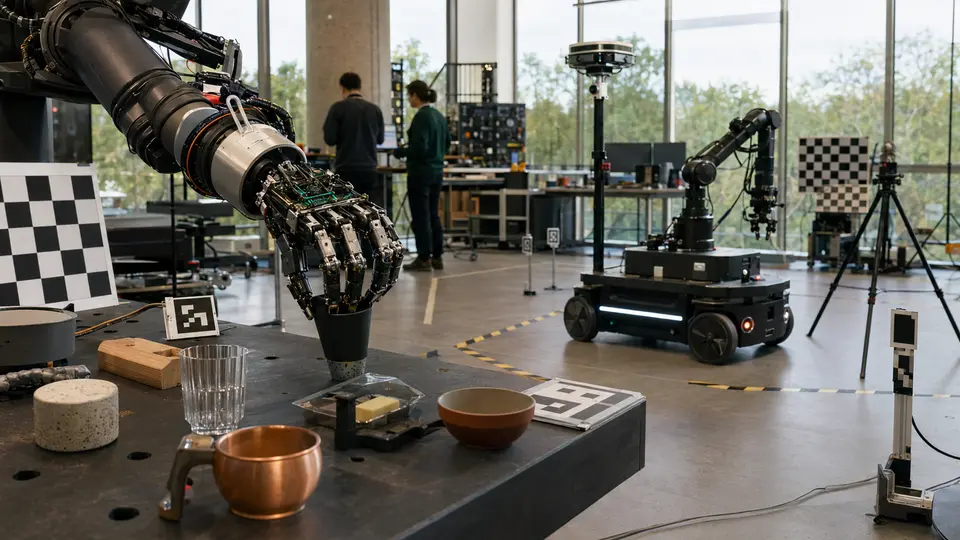
World models, vision-language-action systems and cross-embodiment learning are expanding robot capability, while renewed safety standards and monitoring practices are developing in parallel. Open-world reliability, rare-event behaviour and meaningful human intervention remain incompletely evidenced.
Open evidence dossier ↗
AI is producing useful predictions, candidate algorithms, hypotheses and research assistance in domains with strong data or evaluators. The strongest evidence appears where outputs can be independently measured. General claims of autonomous discovery remain premature without prospective validation, provenance and reproducible experimental records.
Open evidence dossier ↗
AI growth is now inseparable from electricity systems, data-centre geography, cooling, chips, networks and capital allocation. Efficiency and flexible compute can reduce some constraints, yet rebound effects, local grid bottlenecks and supply concentration make the net outcome uncertain.
Open evidence dossier ↗
Field evidence shows meaningful gains in some tasks, including the diffusion of expertise, while effects remain uneven across workers, workflows and decision types. Tool access alone does not redesign work. Outcomes depend on task structure, user skill, organisational change, feedback and accountable human judgment.
Open evidence dossier ↗Evidence-state language
The Atlas does not publish percentage confidence scores. Evidence states describe the quality and consistency of the public record, not mathematical certainty.
Multiple credible records support a bounded claim, while stated limitations still apply.
The direction is visible, but the evidence base, operating history or independent validation remains incomplete.
Credible evidence supports more than one interpretation, or outcomes vary materially by context.
The available record does not yet justify a stable public conclusion.
Knowledge architecture
Begin with a consequential question whose answer could change research, engineering, governance or long-term allocation.
Write the narrowest useful claim so evidence can support, limit or contradict it without ambiguity.
Connect primary records, operating evidence and independent research to the specific claim they inform.
Preserve competing explanations, boundary conditions and evidence that does not fit a simple narrative.
State what the record changes—and what it does not justify—for researchers, builders and institutions.
Reading paths
Use dossiers to identify where evidence is strong enough to build on, where independent replication is still needed and which assumptions should enter experimental design.
↗02For buildersSeparate demonstrated capability from unresolved system risk, then connect each claim to an observable engineering requirement.
↗03For institutionsRead evidence position, conflicting interpretations, unknowns and decision relevance together rather than relying on a single forecast.
↗Recently reviewed signals
AlphaEvolve shows a repeatable pattern: models propose candidate programs, objective evaluators test them, and an evolutionary loop retains better solutions. Its reported applications now span computing, mathematics, genomics, power systems and Earth science.
The value of an algorithm-discovery agent depends on whether candidate outputs can be tested quickly, consistently and at scale. Better evaluators can turn broad model creativity into dependable experimental progress.
Reported AlphaEvolve results include optimized procedures and candidate solutions across multiple formal domains. Because code can be executed and measured, an algorithm can serve as both a hypothesis and a testable artifact.
The same discovery pattern has been reported in compute, quantum circuits and power-flow optimization. Small algorithmic gains can matter repeatedly when embedded in high-volume infrastructure.
As autonomous search contributes to consequential engineering and scientific results, knowing which model, prompt, evaluator, data and human decision produced a method becomes part of its credibility.
Stanford researchers describe Item Response Scaling Laws, a method that chooses informative evaluation items rather than exhaustively testing every model on every question. Their reported experiments preserve or improve prediction while sharply reducing queries.
Research integrity
Stable record IDs, primary-source links, review dates, limitations, correction routes and revision history are part of the knowledge—not administrative detail around it.
A growing public institution
New dossiers enter only when the question is consequential, credible sources are available, uncertainty can be stated honestly and the record can be maintained. Earlier versions remain part of the revision trail.