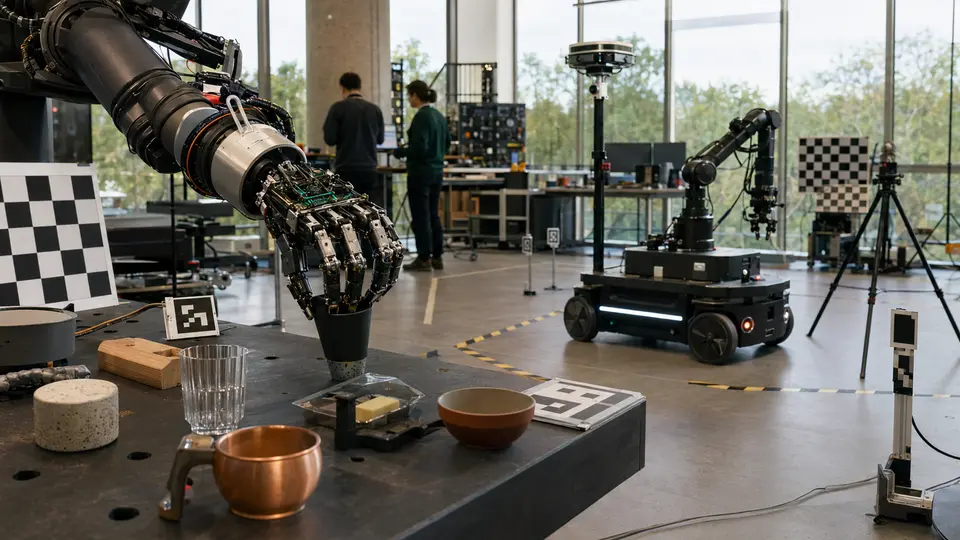
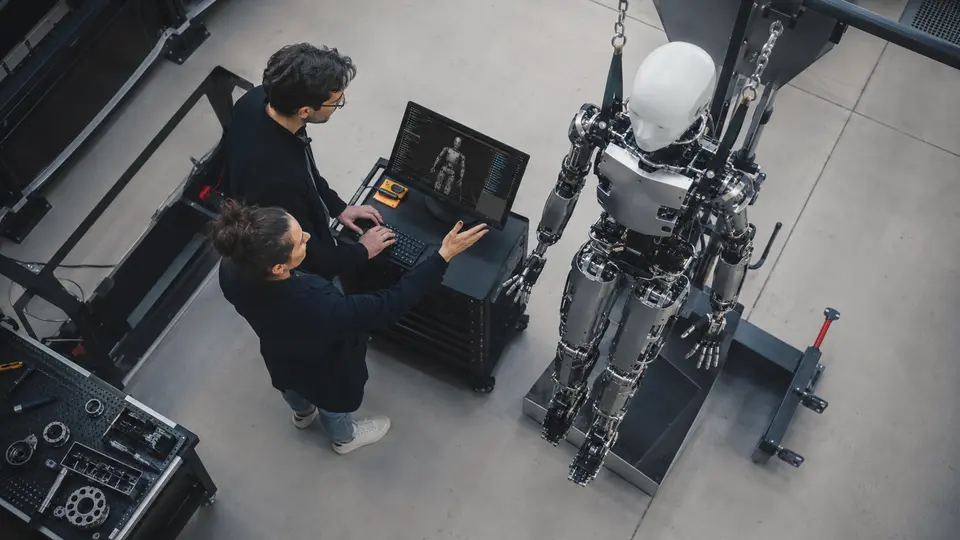
Embodied AI safety and human oversight

FUURAA AI Evidence Atlas · Evidence dossier 03

What evidence is required before embodied AI can be trusted to act around people in open, changing environments?

World models, vision-language-action systems and cross-embodiment learning are expanding robot capability, while renewed safety standards and monitoring practices are developing in parallel. Open-world reliability, rare-event behaviour and meaningful human intervention remain incompletely evidenced.

Current evidence position
Developing
Related research field
Embodied intelligence
Last reviewed
Record version
1.0
01

Why this question matters

Embodied systems turn inference into physical consequence. A software error can become motion, force, collision, exclusion or unsafe reliance. Safety therefore depends on the complete operating system: perception, control, hardware limits, environment design, human roles and incident learning.

02

Scope and disclosure boundary

This dossier examines evidence on world models, robot foundation models, transfer, human oversight, monitoring, safety standards and deployment learning. Industry demonstrations are treated as bounded evidence, not proof of general autonomy.

03

Current evidence position

The direction is visible, but the evidence base, operating history or independent validation remains incomplete.

This evidence dossier synthesises public records. It is not investment, medical, legal or safety certification advice, and it does not claim that FUURAA has completed the systems discussed.

Claim-to-evidence map

The dossier preserves support, tension and uncertainty together.

01

What the current record supports

  • Predictive world representations and heterogeneous training data can improve transfer across tasks and embodiments.
  • Robot policies are increasingly combining perception, language, planning and low-level control in shared architectures.
  • Industrial and service-robot safety requires system-level controls beyond model evaluation alone.
  • Monitoring, operating limits and incident analysis need to continue after deployment.
02

Where evidence or interpretation diverges

  • Learning from deployment can improve performance while exposing people and environments to immature behaviour.
  • Generalist policies may reduce retraining while making failure boundaries harder to specify.
  • Remote supervision can extend human reach, but attention limits and latency can make nominal oversight ineffective.
03

What remains unknown

  • Which evaluations predict safe behaviour in homes, streets and workplaces rather than curated demonstrations?
  • How should responsibility be allocated among model provider, robot maker, deployer, operator and site owner?
  • What evidence should be required before a robot can expand its operating envelope?

Primary evidence records

Read the public records behind the current evidence position.

EV-03-01Google DeepMind · 2025-08-05

World models are moving beyond passive video generation

Genie 3 demonstrates text-conditioned environments that can be navigated and changed in real time while preserving short-term consistency. This turns generated media into an interactive system with state and consequences.

FUURAA interpretation

The frontier is not only more realistic imagery, but environments in which people and agents can act, observe outcomes and learn.

EV-03-02Meta AI Research · 2025-06-11

Video pretraining can teach predictive structure about the world

V-JEPA 2 learns from large-scale video and image data to represent motion, anticipate actions and support planning. It emphasizes prediction in a learned representation rather than reconstructing every visible pixel.

FUURAA interpretation

Observation-rich training may become a major route to physical understanding, especially where labelled robot demonstrations are scarce.

EV-03-03Physical Intelligence · 2026-04-16

Robot policies are learning both what to do and how

π0.7 accepts varied conditioning such as language, visual subgoals and performance metadata to steer task strategy as well as task identity.

FUURAA interpretation

Future robot interfaces may let operators specify speed, quality, caution and method without rewriting controllers.

EV-03-04NVIDIA · 2025-03-18

Dual-speed architectures are entering humanoid models

GR00T N1 combines a slower vision-language reasoning system with a faster action model for continuous movement.

FUURAA interpretation

Humanoid stacks may increasingly separate deliberate planning from reflex-like control while testing their interaction as one safety system.

EV-03-05ISO · 2025-02-05

Industrial robot safety standards are being renewed

The third edition of ISO 10218-1 updates safety requirements for industrial robots as machines before system integration.

FUURAA interpretation

Robot manufacturers should align risk reduction, design evidence and user information early, not at final certification.

EV-03-06NIST CAISI · 2026-03-06

Monitoring will become risk-tiered

NIST highlights unresolved questions about cadence, responsibility and risk level in deployed-system monitoring.

FUURAA interpretation

Routine drafting agents may be sampled, while financial, medical or physical actions may require near-continuous supervision.

Testable questions

Questions that can move the evidence position—not decorate the debate.

  1. Q1

    Can the system detect and safely exit conditions outside its validated operating envelope?

  2. Q2

    Can a human supervisor understand, interrupt and recover the system within the time available?

  3. Q3

    Do safety results persist across sites, hardware variants, people and environmental change?

Decision relevance

What the record changes for research, engineering and institutions.

01

Research: evaluate rare events, distribution shift and recovery—not only average task success.

02

Engineering: combine model controls with hardware interlocks, safe states, observability and site design.

03

Governance: require deployment-specific evidence, named human responsibilities and a route for incident learning.

Revision record

A conclusion is a maintained record, not a permanent slogan.

Version 1.0 establishes the initial public synthesis. Future revisions will record changes in evidence position, sources, scope and unresolved questions. Earlier records are not silently erased.

Corrections, missing primary evidence and material counter-evidence can be submitted through the FUURAA contact route. Inclusion is subject to source verification and editorial review.
1.0
Initial public evidence synthesis

Continue through the Evidence Atlas

Evidence develops through connected questions.

04Mixed

When does AI accelerate genuine scientific discovery, and what records are needed to make machine-assisted results reproducible?

05Developing

How can AI capability grow without making energy, grid capacity, water, chips and geographic concentration invisible externalities?

00FUURAA AI Evidence Atlas

Return to the complete dossier directory.