
External insight · International Federation of Robotics
From Perception to Autonomy: Where AI Is Changing Robotics
The International Federation of Robotics maps AI applications across perception, language, navigation and control—and the safety questions that follow.
Read the original source ↗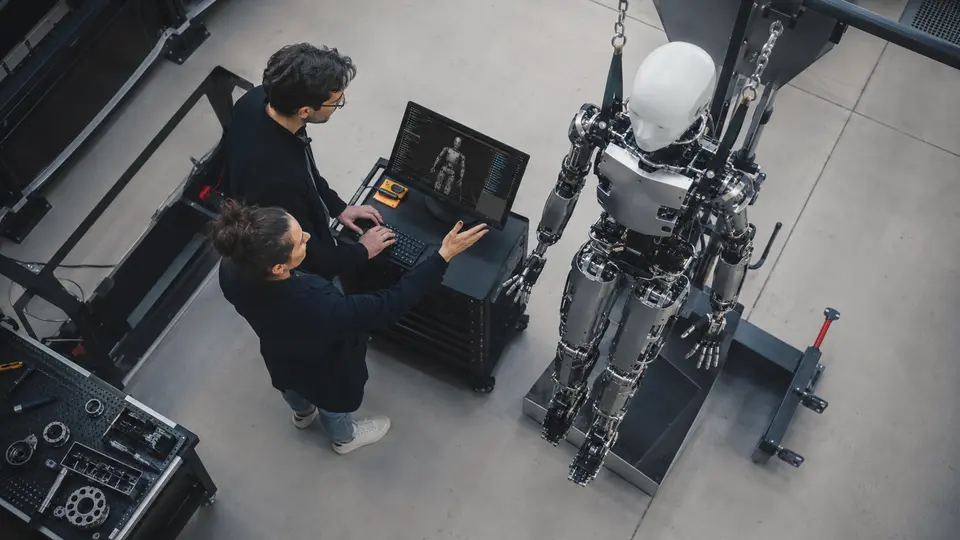 Conceptual visual
This is FUURAA’s own editorial analysis of the cited public source, prepared independently from the cited institution. Source materials remain attributable to their authors and publishers; FUURAA is responsible for their selection, synthesis and interpretation. No cited institution has reviewed or endorsed this article unless expressly stated.
External evidence
What the public source says
The IFR describes how computer vision, natural-language processing, sensor fusion, SLAM, reinforcement learning and generative AI are extending robotic capability across logistics, manufacturing and services.
It also highlights the other side of embodiment: cybersecurity, compromised data, bias, unpredictable behaviour, physical safety and energy use. Failures in the physical world can carry consequences beyond a software error.
FUURAA editorial analysis
FUURAA editorial perspective
Evidence-led analysis in the public interest
Embodied intelligence is not simply an AI model placed inside a machine. It joins perception, planning, actuation, human interaction, security, maintenance and physical risk into one operating system.
FUURAA treats humanoid systems as a long-term development direction. AFUU™在复™ Humanoid Platform remains in development; this article describes the wider field, not a claim about completed AFUU™在复™ capabilities.
- Embodied intelligence is a system-level engineering problem joining perception, language, navigation, control, actuation, security, maintenance and human interaction.
- Greater robotic autonomy can create practical value, but physical-world consequences make reliability, cybersecurity and recovery central design requirements rather than later additions.
- Public understanding should distinguish documented industry trends from the capabilities of any individual platform that remains under development.
Robotics is becoming an integrated AI stack
The International Federation of Robotics describes computer vision, natural-language processing, sensor fusion, SLAM, reinforcement learning and generative AI as technologies extending robotic capability across logistics, manufacturing and services. Their importance lies not only in individual performance but in how they operate together. A robot must translate perception into a plan, a plan into physical action and that action into a new understanding of its surroundings. Each transition can introduce uncertainty. Embodied intelligence should therefore be assessed as a connected operating system rather than as a model demonstration or a collection of impressive features.
Physical action changes the meaning of error
The IFR also identifies cybersecurity, compromised data, bias, unpredictable behaviour, physical safety and energy use as material challenges. In software, a mistaken output may sometimes be corrected before it affects the world. A robot can move, carry, navigate or interact with people and equipment, so an error can become physical before it is recognised. This does not mean autonomous systems should be rejected; it means permissions, operating limits, monitoring and safe recovery must be designed around the consequences of each application. The acceptable level of autonomy should follow the task and environment, not a general ambition to maximise autonomy.
Applications should be evaluated by context
Industry, logistics and human-facing services present different operating conditions. Adaptive inspection, movement and material handling may reduce repetitive exposure, while natural-language interaction may make systems easier to use. Yet a capability that is appropriate in a controlled facility may not be suitable in an open environment or around vulnerable users. Evaluation should consider who is present, what the machine can affect, how uncertainty is detected and whether a responsible person can intervene. Maintenance is equally important: predictive maintenance and efficient control may extend useful life, but only if degradation and failures remain observable.
Claims must remain proportional to evidence
Robotics communication often moves quickly from a laboratory capability to an implied general-purpose product. A fairer approach separates research demonstrations, bounded deployments and verified operational performance. FUURAA treats humanoid robotics as a long-term development direction, while AFUU™在复™ Humanoid Platform remains in development. The industry capabilities discussed here should not be read as completed AFUU™在复™ functions. Maintaining this boundary is important for public trust and for engineering discipline: future claims should be tied to testing, operating conditions and clearly stated limitations.
Alternative views & uncertainty
What this evidence does not settle
- Not every useful robotic application requires a humanoid form or broad autonomy. Simpler machines and more limited operating boundaries may deliver clearer reliability for particular tasks.
- Strict controls can reduce flexibility and slow deployment, but removing them does not eliminate risk; it transfers uncertainty to users, workers and the surrounding environment.
Public-interest implications
What this means for different stakeholders
People need clear explanations of what a robot can do, where it can operate, who supervises it and how incidents are reported or stopped.
Assess the complete operating system, including cybersecurity, maintenance, human interaction and recovery, rather than purchasing on feature claims alone.
Requirements should reflect physical consequences and operating context while remaining proportionate to the risk of the specific application.
Prioritise measurable reliability, uncertainty detection, safe intervention and long-term performance across perception, planning and actuation.
What to watch next
- Whether public demonstrations are accompanied by defined operating conditions and evidence of repeatable performance.
- How robotic systems detect compromised data, unpredictable behaviour and degradation before these produce physical harm.
- Whether energy use, maintenance and useful life are evaluated alongside capability and autonomy.
AI is expanding what robots can perceive, understand and attempt, but embodiment raises the standard of responsibility. Progress should be measured by dependable operation, appropriate autonomy and the ability to fail safely—not by novelty alone. The most credible path combines ambitious research with disciplined boundaries, transparent evidence and continuous attention to people sharing the physical environment. FUURAA supports this direction while keeping its assessment of the wider field separate from claims about platforms that have not completed development.
This is an independent FUURAA editorial analysis of the cited IFR material. It does not represent the IFR, imply its endorsement of FUURAA or AFUU™在复™, or attribute industry-wide capabilities to a platform still in development.
Forward view
Areas of application
Industry and logistics
Adaptive inspection, movement, material handling and safer repetitive work.
Human-facing services
Natural interaction may improve usability, but requires careful social and safety design.
Maintenance and resilience
Predictive maintenance and efficient control can extend useful life and reduce waste.
Continue reading
Related insights

26 July 2026
FUURAA Corporate Website V1.0: A Clear Public Source
FUURAA Corporate Website V1.0 brings the group’s identity, direction, confirmed products, research, governance information and contact routes into one official public source.Read insight →
17 February 2026
Why AI Agents Need Infrastructure, Not Only Stronger Models
NIST’s 2026 AI Agent Standards Initiative puts interoperability, open protocols, security and agent identity at the centre of trusted adoption.Read insight →
20 May 2026