
AI-discovered efficiency can compound across infrastructure
The same discovery pattern has been reported in compute, quantum circuits and power-flow optimization. Small algorithmic gains can matter repeatedly when embedded in high-volume infrastructure.
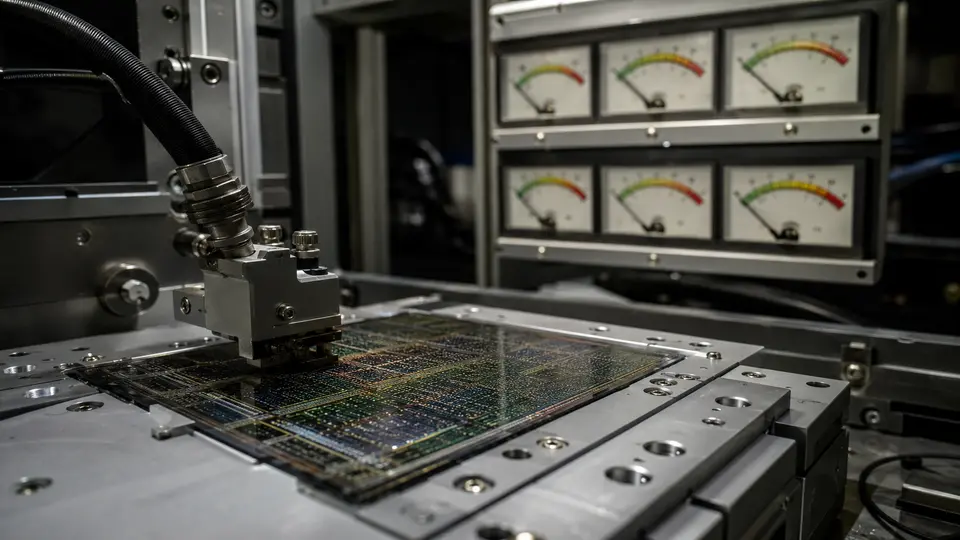 FUURAA original conceptual visual
What the evidence indicates
The Core Argument of “AlphaEvolve: How our Gemini-powered coding agent is scaling impact across fields”
The same discovery pattern has been reported in compute, quantum circuits and power-flow optimization. Small algorithmic gains can matter repeatedly when embedded in high-volume infrastructure.
FUURAA Editorial Analysis
Reading “AlphaEvolve”: Can AI-Discovered Efficiency Compound Across Infrastructure?
AlphaEvolve’s infrastructure cases point to a different route for AI progress: instead of only building larger models, use machine-guided search to improve the schedulers, kernels, circuits and operational procedures underneath them. Small gains can matter when repeated across high-volume systems. The central question is whether the gains survive full-system measurement, deployment change and the cost of finding them.
The Core Argument of “AlphaEvolve”
The May 2026 impact report extends AlphaEvolve’s reported use from Google computing and mathematics into genomics, grid optimization, quantum circuits and Earth science. Its earlier technical introduction described production and engineering cases in data-center scheduling, accelerator circuits, model training and low-level kernels. Together, these reports support a practical thesis: executable search can discover narrow improvements at several layers of a computational stack, and a small improvement may be multiplied by repeated execution. This is stronger evidence than a laboratory benchmark alone because some methods entered operational workflows. It is still provider- and collaborator-reported evidence, however, and the tasks use different objectives and baselines. The percentages should not be added into one total efficiency claim.
Why small improvements can become strategically large
Infrastructure economics are governed by repetition. A scheduling rule may run across a fleet, a kernel may be invoked during every training step, and a circuit change may be replicated across future hardware. A gain that looks modest in one invocation can affect capacity, energy, latency or engineering time at scale. The same logic extends beyond AI compute to grids, logistics and scientific pipelines when the optimized procedure is used frequently. This creates an attractive search target: the value of a verified improvement can greatly exceed the cost of exploring candidates. It also means that durable advantage may sit in the combination of operational telemetry, realistic evaluators and deployment capability, not only in the language model proposing code.
Local speedups do not automatically improve the whole system
A faster component can move a bottleneck instead of removing it. A kernel optimization may increase memory pressure, a scheduler may improve average utilization while worsening tail latency, and a compact circuit may complicate verification or maintenance. Search systems can also optimize for the easiest measurable proxy while missing reliability, security, energy, accessibility or workforce effects. Full-system accounting therefore needs multiple metrics and a declared hierarchy: correctness and safety gates first, then performance objectives, then operational cost. Results should report the baseline, hardware, workload distribution, variance and observation period. Without this context, a percentage improvement can be technically accurate yet misleading for another operator.
Compounding requires deployment discipline
To turn a discovered candidate into recurring value, teams must reproduce it outside the search environment, inspect the code, test adversarial and rare workloads, estimate rollback cost and monitor it after release. A human-readable algorithm may be easier to debug and govern than an opaque learned policy, but readability does not remove the need for staged deployment. Canary exposure, automatic rollback triggers, versioned benchmarks and a retained control group help distinguish a lasting gain from temporary workload fit. Search cost also belongs in the ledger: model calls, evaluator compute, specialist time and validation effort should be compared with the expected lifetime benefit. A positive benchmark is not yet a positive return on infrastructure.
Evidence that should strengthen or weaken the compounding thesis
The thesis becomes stronger when independent operators reproduce gains on different stacks, when improvements persist over long operating periods, and when total resource use falls after search and validation costs are included. It also strengthens when several independently discovered changes can coexist without adverse interactions. It weakens if gains disappear under workload drift, depend on privileged internal data, require continuous expensive search or create new failure modes elsewhere in the system. Readers should watch for audited before-and-after measurements, not only selected best cases. The important frontier is whether AI-assisted optimization becomes a reliable operating practice with predictable economics, rather than a sequence of impressive but non-transferable demonstrations.
FUURAA separates reported facts from editorial assessment. Partner-reported results are not treated as independent verification, and conclusions remain bounded to the named source, date, systems and disclosed operating contexts.
How to read this signal
A direction still taking shape
Multiple developments point in this direction, but timing, adoption and outcomes remain open.