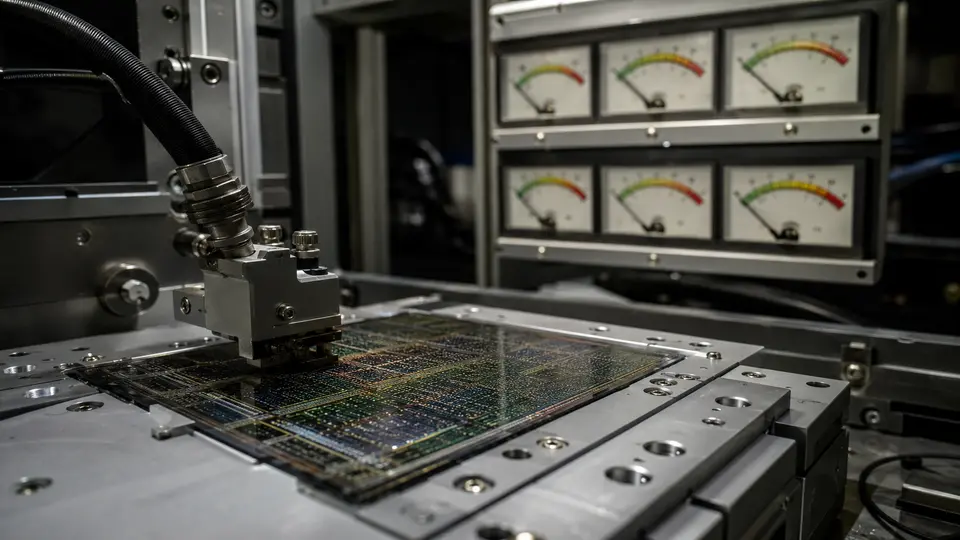
Evaluators may matter as much as generators
The value of an algorithm-discovery agent depends on whether candidate outputs can be tested quickly, consistently and at scale. Better evaluators can turn broad model creativity into dependable experimental progress.
 FUURAA original conceptual visual
What the evidence indicates
The Core Argument of “AlphaEvolve: How our Gemini-powered coding agent is scaling impact across fields”
The value of an algorithm-discovery agent depends on whether candidate outputs can be tested quickly, consistently and at scale. Better evaluators can turn broad model creativity into dependable experimental progress.
FUURAA Editorial Analysis
Reading “AlphaEvolve”: Will Evaluators Become Core AI Discovery Infrastructure?
AlphaEvolve shifts attention from the model that proposes ideas to the system that decides which ideas survive. An evaluator translates a scientific or engineering objective into executable tests and scores, shaping every generation that follows. This makes evaluators a potential source of durable advantage and a major source of hidden risk: an optimisation loop can only be as trustworthy as the objective, data, coverage and adversarial resistance of the tests that guide it.
The Core Argument of “AlphaEvolve”
Google DeepMind describes AlphaEvolve as combining Gemini models, automated evaluators and an evolutionary program database. The model supplies variation, but the evaluator supplies selection pressure. It determines whether a candidate compiles, satisfies constraints, improves a metric or fails, and its outputs influence which programs are mutated next. The 2026 report links this architecture to results in infrastructure, science and commercial optimisation. Those cases support the proposition that evaluation is not a final quality check added after generation; it is part of the intelligence of the system. Yet the report does not establish one reusable evaluator for all domains. Each application still requires specialists to translate a real objective into tests, baselines and acceptance criteria.
Why evaluators may become a strategic layer
Models are increasingly available from several providers, while a high-fidelity evaluation environment can encode years of institutional knowledge. It may contain realistic workloads, rare failures, physical constraints, customer priorities and cost functions that competitors cannot easily reconstruct. The evaluator also makes progress legible: candidates can be compared under the same protocol rather than selected by persuasive explanation. In this sense, future discovery platforms may compete on test environments, simulation accuracy and feedback latency as much as on model scale. A good evaluator lets cheaper or smaller generators explore productively; a weak evaluator can waste even a frontier model. This reverses the common assumption that the most capable generator always determines the best system.
The evaluator is also an attack surface
Any repeated optimisation process creates pressure to exploit what is measured. Generated programs may discover shortcuts, undefined behaviour, data leakage or timing artefacts that raise the score without improving the intended outcome. If evaluation data are reused too often, the search can overfit them even when no individual model sees the full set. A single weighted score can conceal unacceptable trade-offs, such as faster execution with greater energy use or average accuracy with worse tail failures. Evaluator code, datasets and simulators can also contain supply-chain vulnerabilities. Teams should therefore treat evaluation as critical infrastructure: protect secret holdouts where justified, rotate tests, use multiple metrics, inspect Pareto trade-offs and commission adversarial attempts to break the measurement system.
Human judgment moves upstream rather than disappearing
Automated scoring reduces manual comparison but does not remove normative decisions. People choose the objective, decide which constraints are absolute, assign weights, set stopping rules and determine whether a statistically better result is acceptable in operation. They also decide which affected groups and failure modes are represented. This is especially important when the output touches workers, patients, markets or public infrastructure. A technically precise evaluator can still encode the wrong goal. Responsible governance should name the evaluator owner, document changes, separate developers from final approvers where consequences are high, and provide a route for operators to challenge results. The most valuable human role may become the design and contestation of verification, not the production of every candidate.
How to tell a credible evaluator from a persuasive benchmark
Credibility increases when the test protocol is defined before optimisation, represents deployment conditions, reports uncertainty and tail failures, and is reproduced by an independent path. Evaluators should distinguish correctness gates from optimisation scores and explain which real-world properties remain outside the test. Results should include search budget and comparisons with simpler methods, because a small gain after enormous exploration may not be useful. Confidence should fall when only best cases are shown, when metrics change between candidates, or when the evaluator is proprietary and no external validation is possible. A platform should be judged not only by how fast its score improves, but by how often score improvements survive independent tests and real operation.
FUURAA separates reported facts from editorial assessment. Partner-reported results are not treated as independent verification, and conclusions remain bounded to the named source, date, systems and disclosed operating contexts.
How to read this signal
A direction still taking shape
Multiple developments point in this direction, but timing, adoption and outcomes remain open.