Core-process integration creates the value gap
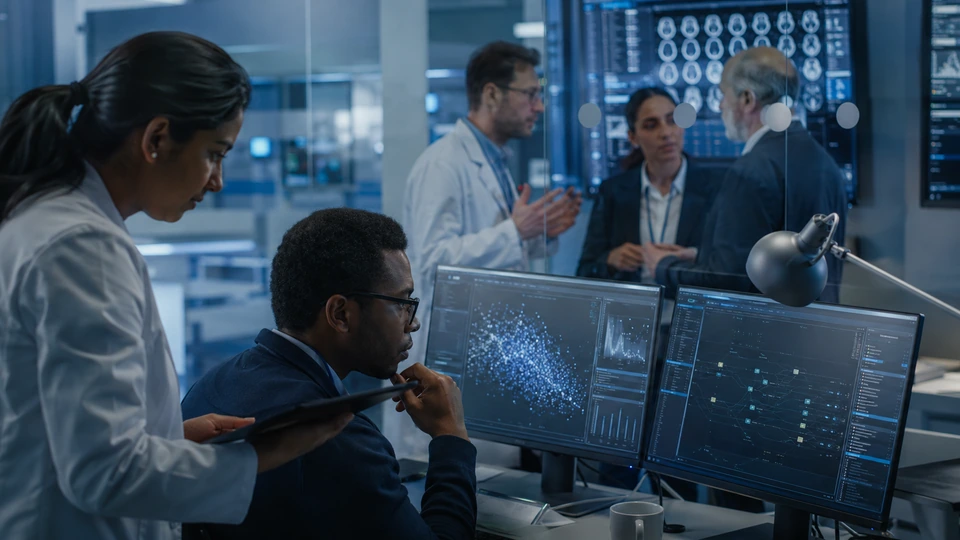
Intensive users are more likely to connect AI with growth, research and product expansion, while moderate users focus on isolated efficiency savings. The distinction points to a widening operating-model gap.
 FUURAA original conceptual visual
What the evidence indicates
The Core Argument of “What separates firms that use AI intensively from firms that don’t?”
Intensive users are more likely to connect AI with growth, research and product expansion, while moderate users focus on isolated efficiency savings. The distinction points to a widening operating-model gap.
FUURAA Editorial Analysis
Reading “What Separates Firms That Use AI Intensively from Firms That Don’t?”: Why Does Core-Process Integration Matter?
The ECB evidence suggests that the value gap between light and intensive AI users is not explained by tool access alone. Intensive users more often connect AI with research, growth, employment and product expansion, while earlier-stage users more often emphasise cost reduction and routine efficiency. The operational implication is demanding: value emerges when technology, data, decision rights and accountability are redesigned around a real process. Integration can create advantage, but it can also scale errors, dependency and hidden work unless outcomes and control points remain visible.
The Core Argument of “What Separates Firms That Use AI Intensively from Firms That Don’t?”
The 24 June 2026 ECB Blog article analyses late-2025 SAFE responses from more than 5,000 euro-area firms. It reports that intensive AI users more frequently cite innovation, research and development, employment growth, and expansion of products or services, whereas less intensive users more commonly focus on operational efficiency and cost. Only 7 per cent of firms describe significant use, despite more than 70 per cent reporting some use. These associations support a distinction between peripheral experimentation and core-process integration. They are not independent verification that integration caused growth: firm ambition, digital maturity, sector, finance and management quality may influence both depth and outcomes, and the survey does not provide a causal return-on-investment estimate for any one workflow.
Core integration joins four systems that pilots often keep separate
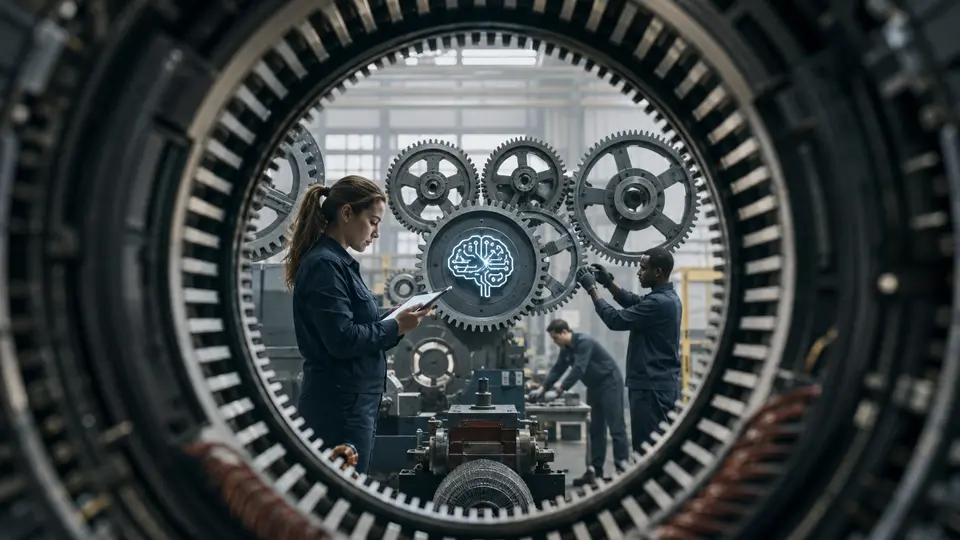
A production process combines work instructions, data, software and authority. A pilot can succeed with a clean sample and an enthusiastic team while avoiding legacy records, exception queues, compliance review and service commitments. Core integration removes that shelter. The AI system must receive governed data, produce outputs in a usable format, fit existing controls and hand uncertain cases to an accountable person. It also needs a service owner who can decide when a model update, supplier change or incident requires revalidation. The hard work is therefore architectural and organisational as much as algorithmic. Without shared identifiers, versioned prompts and policies, observable hand-offs, access control and recovery procedures, a promising model remains an isolated feature rather than dependable operating capacity.
The value gap should be expressed as a process-level investment case
Executives need a causal chain from capability to outcome. The chain might begin with faster document classification, proceed to shorter case preparation, and end in quicker service without lower accuracy. Each link requires a metric and a named owner. Costs must include integration engineering, data remediation, evaluation, monitoring, review labour, training, procurement, security and the option value of maintaining a fallback. Benefits should separate direct savings from increased capacity, better quality, new revenue and learning. This prevents a common error: assigning every improvement after deployment to the model while ignoring simultaneous redesign. A strong case also states the minimum scale and duration at which the investment breaks even, plus the conditions under which a smaller assistive implementation would be preferable.
Deep integration raises the assurance burden
When AI sits at the edge of work, an employee can ignore it. When it shapes a core queue, customer interaction or production decision, errors propagate faster and become harder to detect. Institutions should map which outputs are advisory, which can trigger actions, who can override them and how affected people seek correction. Monitoring must cover drift, missing data, automation bias, unequal performance and upstream system changes, not only model latency. Supplier continuity and portability also matter because a process can become dependent on one interface or model family. Core integration is most defensible when authority remains proportionate, logs support reconstruction, high-consequence cases receive qualified review and an outage or model withdrawal does not make essential service impossible.
What evidence should change the assessment
The case for a durable value gap would strengthen if longitudinal studies showed that firms integrating AI into specific core processes outperform comparable light users after accounting for prior digital capability, investment and sector, while maintaining quality and worker outcomes. It would be stronger still if the mechanism were reproducible: governed data, complementary training and clear process ownership should predict results across providers. The assessment should weaken if benefits concentrate in already exceptional firms, if core integration mainly increases vendor dependency, or if review and remediation costs erase headline productivity. Organisations should publish unsuccessful trials, incident rates, human-work redistribution and total lifecycle cost. Those records would reveal whether integration is a transferable operating method or merely a label attached to high-performing firms.
FUURAA separates reported facts from editorial assessment. Partner-reported results are not treated as independent verification, and conclusions remain bounded to the named source, date, systems and disclosed operating contexts.
How to read this signal
A direction still taking shape
Multiple developments point in this direction, but timing, adoption and outcomes remain open.