
Education AI must improve learning, not output
Generative AI can make assignments faster without necessarily deepening understanding. Effective use should be judged by durable knowledge, reasoning and learner agency.
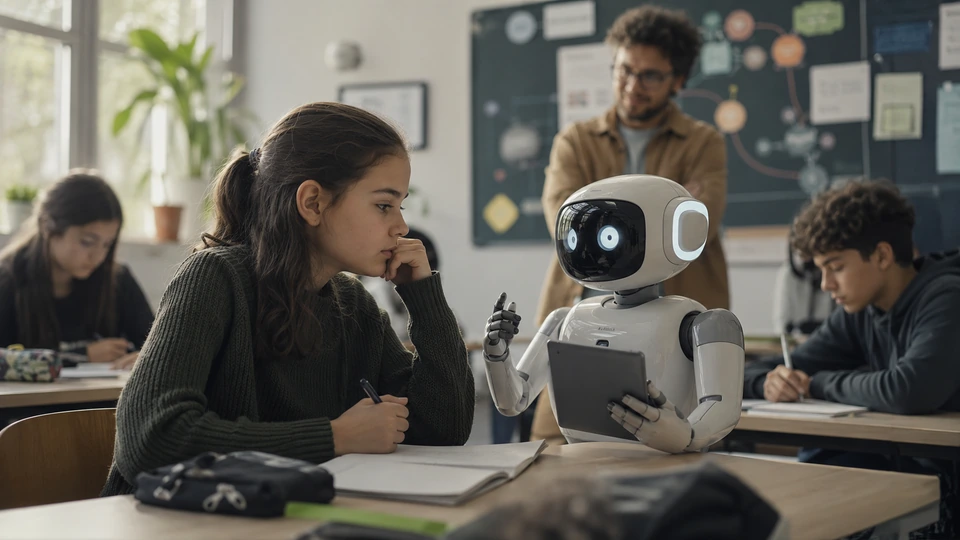 FUURAA original conceptual visual
What the evidence indicates
The Core Argument of “OECD Digital Education Outlook 2026”
Generative AI can make assignments faster without necessarily deepening understanding. Effective use should be judged by durable knowledge, reasoning and learner agency.
FUURAA Editorial Analysis
Reading “OECD Digital Education Outlook 2026”: Does Education AI Improve Learning or Only Output?
The OECD Digital Education Outlook 2026 makes a distinction that should govern every education-AI decision: producing a better answer while a tool is available is not the same as retaining knowledge, transferring a method or becoming able to solve a new problem without the tool. Generative AI can support learning, but only when the activity protects the cognitive work that learning requires and measures outcomes beyond the assisted task.
The Core Argument of “OECD Digital Education Outlook 2026”
The Outlook synthesises emerging studies of generative AI in classrooms and related learning settings. Its central warning is that general-purpose tools can raise the quality of an assignment without producing a corresponding learning gain. In some cited settings, students performed better during AI-assisted practice but did not preserve that advantage when assessed without the tool. By contrast, purpose-built systems with an explicit pedagogical design, or general tools used within a carefully structured teaching method, show more promising learning outcomes. The evidence supports a decision rule rather than a universal product ranking: ask what capability the learner should retain after assistance is removed. The OECD synthesis is a primary institutional source, but it is not independent verification of every cited product, age group, subject or classroom.
Performance, learning and transfer are different outcomes
A polished essay, correct calculation or fast summary is an observable product. Learning is a change in what the learner can later understand or do. Transfer is harder still: the learner must apply a principle to unfamiliar material. Education AI can improve the first outcome by supplying wording, intermediate steps or examples while weakening the second if it removes retrieval, explanation, error correction and sustained attention. This does not make assistance inherently harmful. Calculators, worked examples and feedback also reduce effort in useful ways. The design question is which effort is productive for the learning objective. If the objective is to compare arguments, an AI-generated outline may free attention for critique. If the objective is to learn how arguments are constructed, the same outline may remove the practice that matters.
A learning-first activity needs an explicit mechanism
A credible AI-supported lesson should name the intended knowledge or skill, the learner action expected to build it, the role assigned to the tool and the assessment that will test retention or transfer. Useful patterns include asking learners to predict before receiving feedback, explain why a generated answer is wrong, compare alternative solutions, revise from evidence, or reconstruct a method after the tool is closed. Teachers can vary when help appears and gradually withdraw it. Logs of prompts or time on task are not learning measures by themselves. More informative evidence includes delayed recall, unassisted problem solving, application to a new context and the learner's ability to explain a decision. The same system may therefore be helpful in one sequence and counterproductive in another.
The strongest counterarguments and applicability limits
It would be too simple to claim that all unassisted effort is educational and all AI assistance is substitution. Novices can become stuck, inaccessible materials can exclude learners, and immediate feedback can prevent misconceptions from consolidating. Students with language, disability or confidence barriers may gain access to practice that was previously unavailable. Conversely, a purpose-built label does not prove efficacy, and an apparently active exercise can still train superficial routines. Most current studies are bounded by subject, duration, population, implementation quality and rapidly changing models. Schools should not generalise one mathematics trial to writing, early childhood or vocational practice, nor treat a short improvement as evidence of durable knowledge. Equity also requires checking who gains, who becomes dependent and whose data or language is poorly represented.
What evidence should change the assessment
Confidence should rise when preregistered or transparently reported studies compare AI-supported and relevant non-AI instruction, measure delayed and unassisted performance, test transfer, report differential effects and describe teacher implementation. Replication across schools, languages, ages and prior-attainment groups would show whether a mechanism travels. Evidence should include dropout, over-reliance, error patterns and teacher workload rather than reporting average task scores alone. The assessment should weaken if gains disappear after tool removal, if learners cannot explain their answers, if benefits depend on constant expert supervision that is absent at scale, or if disadvantaged groups receive lower-quality feedback. The decisive evidence is not how impressive the generated work looks, but what human capability remains.
FUURAA separates reported facts from editorial assessment. Partner-reported results are not treated as independent verification, and conclusions remain bounded to the named source, date, systems and disclosed operating contexts.
How to read this signal
Documented development
The underlying event, report or finding has been published. Its future consequences may still be uncertain.