Robot applications will specialize above shared models
A reusable physical intelligence layer can let companies focus on hardware integration, workflow design and service delivery.
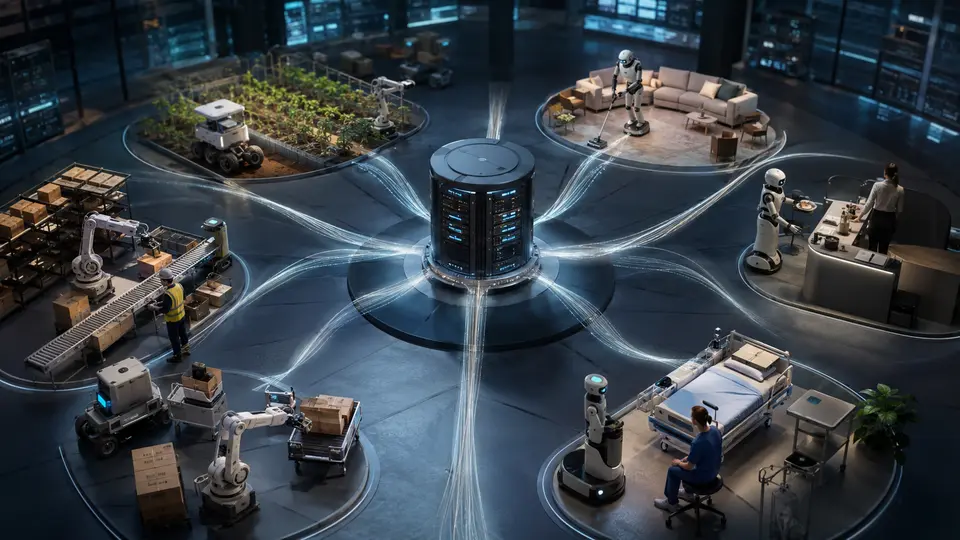 FUURAA original conceptual visual
What the evidence indicates
The Core Argument of “The Physical Intelligence Layer”
A reusable physical intelligence layer can let companies focus on hardware integration, workflow design and service delivery.
FUURAA Editorial Analysis
Reading “The Physical Intelligence Layer”: Will Robot Applications Specialize Above Shared Models?
A shared robot-policy layer could allow application companies to specialise in hardware, workflows and service, but this is a forecast about industrial structure rather than an observed endpoint. The partner cases make the forecast plausible; they do not determine whether the market will standardise around a few model providers, several sector-specific stacks or vertically integrated companies.
The Core Argument of “The Physical Intelligence Layer”
Physical Intelligence argues that roboticists should eventually build applications above general-purpose policies in a manner analogous to developers building above language models. Its partners illustrate one possible arrangement: a model organisation develops the reusable policy, while deployment companies connect it to laundry and warehouse systems, provide task data and operate the customer service. If this pattern generalises, robotics could separate into foundation-policy providers, embodiment manufacturers, integration and safety platforms, and vertical operators. Such separation would let each participant specialise and could support many more applications than a world in which every company owns the entire research and deployment stack.
Conditions required for specialisation
Industrial layers form only when interfaces are stable enough that one participant can change without forcing every other layer to be rebuilt. Robotics therefore needs more than capable models. It needs machine-readable descriptions of sensors, actuators and kinematics; predictable timing; common data and evaluation formats; versioned adapters; explicit authority limits; and evidence that a policy change will not invalidate the deployed safety case. Application companies also need access terms that are dependable over a product lifecycle. If pricing, model behaviour or hardware support can change without notice, vertical builders may prefer greater integration. Standards can help, but premature standardisation can lock the field around interfaces that do not yet represent the real diversity of physical tasks.
Why vertical expertise remains central
A foundation policy does not know by itself what a good laundromat, warehouse, clinic or hotel operation looks like. Vertical companies define the task, acceptable output, exception path, service promise and economics. They choose hardware, redesign workstations, train staff, handle customers and carry operational consequences. Their domain data often contain the difference between an impressive generic capability and a dependable service. Shared models may therefore increase the value of vertical expertise rather than commoditise it. When common perception and manipulation become easier to obtain, competitive advantage moves toward workflow design, distribution, trust, maintenance and the ability to prove outcomes over time.
Economic and governance fault lines
Specialisation lowers duplicated research but introduces dependency. Operators may face model lock-in, changing inference costs, discontinued versions or restrictions on using local data. Model providers may be exposed to uses they cannot observe or control. Hardware makers may struggle to support many policy interfaces. Responsibility can become fragmented when a failure involves perception, a policy update, an adapter, a worn actuator and a site procedure at once. Sustainable platforms will need contracts and records that allocate authority, data rights, update obligations, incident response and liability without pretending every problem belongs to one layer. Customers also need a route to challenge outcomes and identify which organisation can remedy a failure.
Signals that the forecast is becoming reality
The specialisation thesis gains support when independent application companies integrate the same policy through documented interfaces; when switching or upgrading models does not require redesigning the complete system; when safety and performance evidence transfer across supported embodiments; and when vertical firms can build sustainable unit economics without owning a frontier research lab. Open implementations, interoperable evaluation suites and transparent version histories would strengthen the ecosystem. The thesis weakens if successful products remain tightly coupled to proprietary hardware and private data, if adaptation costs dominate, or if liability forces each operator to validate the full stack as a unique system. Industry structure should be inferred from repeated deployments and contracts, not from architectural elegance alone.
FUURAA separates reported facts from editorial assessment. Partner-reported results are not treated as independent verification, and conclusions remain bounded to the named source, date, systems and disclosed operating contexts.
How to read this signal
A forward-looking synthesis, not a prediction of certainty
FUURAA has combined evidence with long-range reasoning. Readers should treat it as a question to examine, not as a statement of future fact.