Robotics is forming a reusable intelligence layer
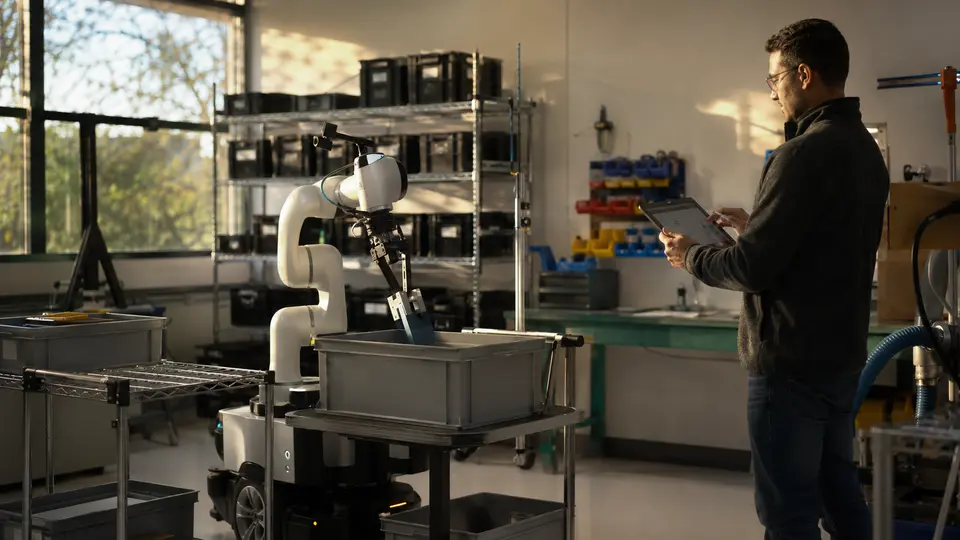
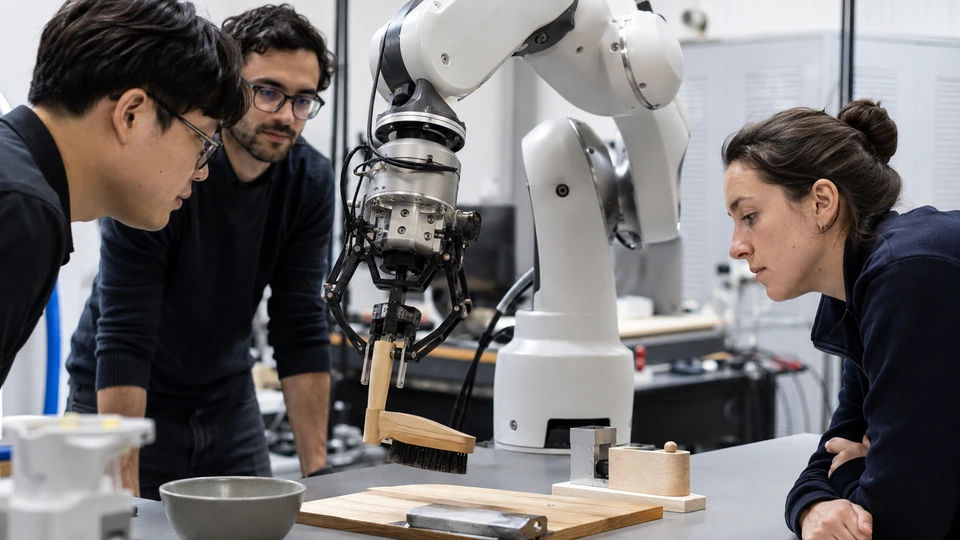
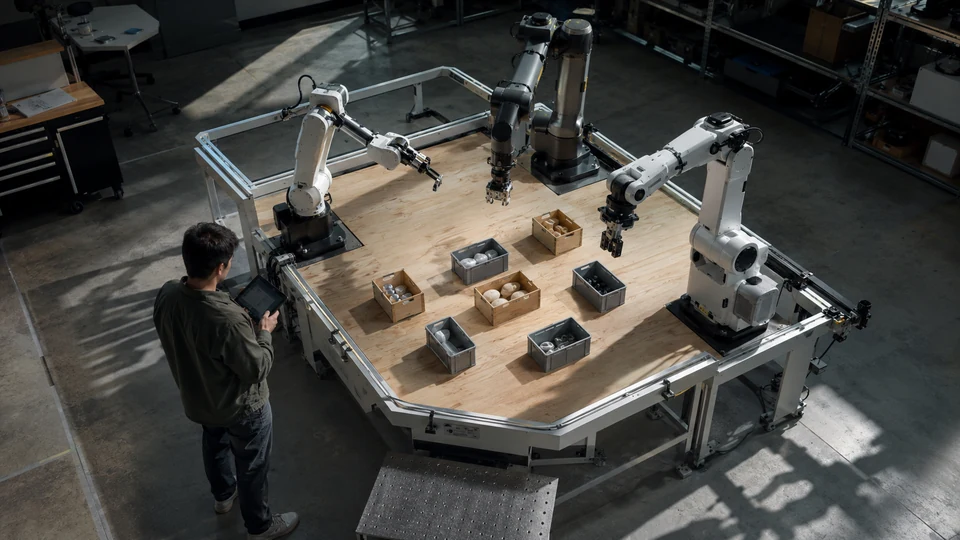
Physical Intelligence describes foundation policies as a shared layer that can reduce the need for every application team to build controllers and data pipelines from scratch.
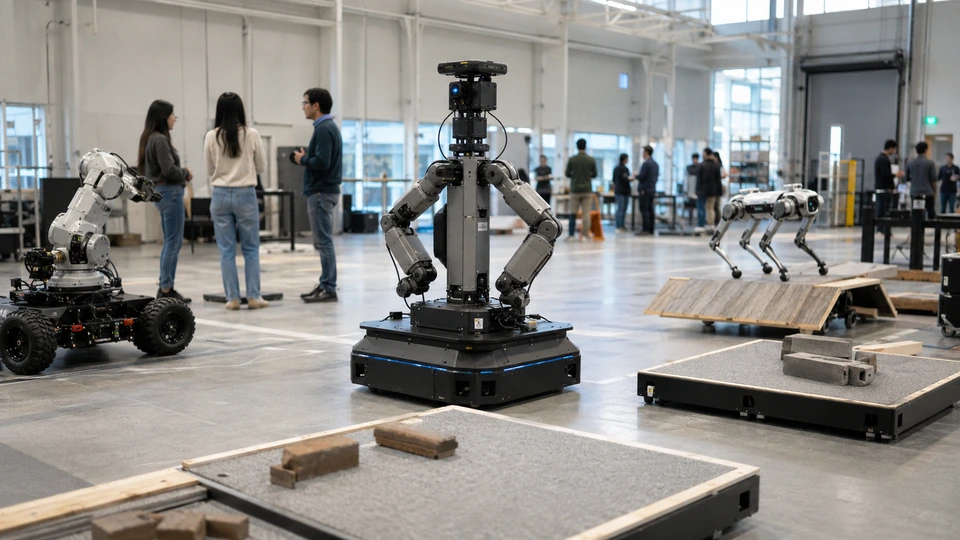 FUURAA original conceptual visual
What the evidence indicates
The Core Argument of “The Physical Intelligence Layer”
Physical Intelligence describes foundation policies as a shared layer that can reduce the need for every application team to build controllers and data pipelines from scratch.
FUURAA Editorial Analysis
Reading “The Physical Intelligence Layer”: Can Shared Robot Models Become Infrastructure?
Physical Intelligence's partner report is meaningful because it moves the foundation-policy thesis from a laboratory analogy toward two operating settings. It does not yet prove that robotics has reached an API-like platform era. The useful interpretation lies between those positions: a reusable model layer is becoming technically plausible, while hardware variation, safety, integration and deployment data still prevent the clean separation familiar in software.
The Core Argument of “The Physical Intelligence Layer”
The source combines Physical Intelligence's platform thesis with reports from Weave Robotics and Ultra. Weave describes laundry-folding systems operating at a customer laundromat; Ultra describes robots packing real customer orders. The article reports higher autonomy, fewer missed grasp sequences and fewer interventions for Weave, and improved success, throughput and recovery behaviour for Ultra. These are more consequential observations than a curated laboratory demonstration because workflow variability, customer output and human intervention enter the picture. They remain company and partner-reported results. The public page does not provide enough information to reconstruct every dataset, deployment, baseline, sample size, downtime category or commercial cost. The evidence therefore supports the narrower claim that a shared policy can contribute to useful deployments on more than one embodiment and workflow—not the broader claim that a universal physical-intelligence platform already exists.
Why the software-platform analogy is attractive
Robotics teams repeatedly solve overlapping problems: perception, language grounding, action representation, control adaptation, teleoperation, data cleaning, evaluation and recovery. If part of that work can be concentrated in a foundation policy, application companies can direct more effort toward hardware reliability, workflow design, customer support and domain operations. This resembles the economic effect of software foundation models: capability that once demanded a specialist research group becomes accessible to a wider builder population. The analogy is strategically useful because it identifies a possible division of labour. It also changes what counts as a robotics company. A vertical operator might own the customer relationship and task data without training every policy from the beginning, while a model provider supplies reusable priors, adaptation methods and runtime services.
Why physical intelligence is not simply an API
Software outputs can often be retried, reviewed or contained before they affect the world. Robot actions are coupled to latency, force, wear, calibration, geometry, payload, people and irreversible state changes. The same policy can behave differently after a camera moves, a gripper wears, a supplier changes a component or an object appears outside the training distribution. Integration therefore cannot be reduced to sending a prompt and receiving an action. A credible reusable layer needs embodiment descriptions, timing guarantees, safety envelopes, task-specific acceptance tests, event logs, human takeover and version control. It also needs a way to represent what the model does not know. The platform opportunity is real, but the interface is likely to include models, data contracts, hardware adapters, verification suites and operating controls rather than one universal endpoint.
The strongest counterarguments
Three cautions deserve equal weight. First, the evidence comes from a provider and collaborating companies with incentives to present progress favourably; independent, protocol-matched replication is not shown. Second, two deployment classes do not establish broad transfer across hospitals, homes, construction sites or public environments. Third, the reported systems still use task data, supervised fine-tuning and human intervention. Those features do not invalidate the results, but they weaken any interpretation that the foundation layer removes application engineering. A reusable policy can lower marginal effort without eliminating local data or operational expertise. It is also possible that different safety-critical or high-precision sectors settle on specialised model families rather than one common layer.
What evidence should change the assessment
The thesis becomes stronger when the same frozen or clearly versioned policy transfers across unrelated robots and sites with limited additional data; when intervention, failure, throughput and cost are reported against declared baselines; when independent teams reproduce the integration; and when safety and rollback controls are tested under realistic faults. It becomes weaker if each deployment requires extensive bespoke data, undisclosed engineering or continuous remote rescue, or if performance degrades materially across hardware revisions and new environments. Readers should therefore track adaptation effort and operating reliability, not only task videos. The decisive question is whether reuse survives contact with heterogeneous hardware, customer economics and accountable operation.
FUURAA separates reported facts from editorial assessment. Partner-reported results are not treated as independent verification, and conclusions remain bounded to the named source, date, systems and disclosed operating contexts.
How to read this signal
Documented development
The underlying event, report or finding has been published. Its future consequences may still be uncertain.