
Autonomous task horizons are lengthening
METR proposes measuring agents by the duration of human work they can complete at a stated success rate. Its longitudinal results show rapid growth in the length of software tasks frontier systems can finish under test conditions.
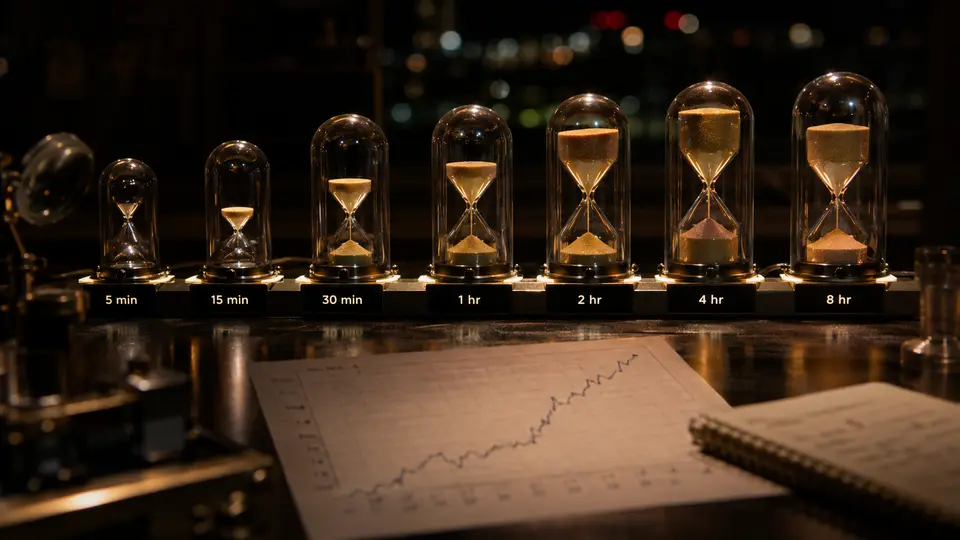 FUURAA original conceptual visual
What the evidence indicates
The Core Argument of “Measuring AI Ability to Complete Long Tasks”
METR proposes measuring agents by the duration of human work they can complete at a stated success rate. Its longitudinal results show rapid growth in the length of software tasks frontier systems can finish under test conditions.
FUURAA Editorial Analysis
Reading “Measuring AI Ability to Complete Long Tasks”: What Does an Agent Time Horizon Actually Measure?
METR’s time-horizon method translates benchmark performance into a more legible question: how difficult are the tasks an AI agent can complete at a stated probability, if difficulty is approximated by the time a relevant human expert needs? The metric is useful because it joins capability with reliability and multi-step work. It is also easy to misread. A two-hour horizon does not mean the agent runs unattended for two hours, can replace two hours of any professional work, or succeeds on every shorter real-world task.
The Core Argument of “Measuring AI Ability to Complete Long Tasks”
The March 2025 study assigns human completion-time estimates to a suite of software, machine-learning, cybersecurity and reasoning tasks, then fits each agent’s probability of success against those durations. The point where the fitted curve crosses a chosen success rate becomes the agent’s time horizon. METR reported that the 50-percent horizon of frontier systems had increased exponentially over the preceding six years, with an approximate seven-month doubling time in the original analysis. The work gives benchmark scores an interpretable unit, but its claim remains conditional on the task suite, agent scaffold, human-time estimates, scoring rules and historical period. METR’s January 2026 Time Horizon 1.1 release expanded and revised the suite, and its current methodology page warns that estimates above sixteen hours are unreliable with the available tasks. This is source-supported analysis, not independent verification or a universal law of AI progress.
Human time is a difficulty proxy, not the agent’s running time
The duration attached to a task describes how long an appropriately skilled human typically needs under the evaluation setup. It does not describe how long the model spends generating tokens or operating tools. An agent may finish a task classified as two human hours in much less wall-clock time, and it may fail after only a few minutes. This distinction matters because the metric attempts to order tasks by the amount of coherent work they demand: understanding a specification, navigating an environment, making several decisions, detecting mistakes and recovering. Human duration is attractive because readers can interpret minutes, hours and days more readily than an abstract benchmark score. Yet duration is not pure complexity. Familiarity, repository context, tool fluency and the quality of the specification can change human performance without changing the underlying objective.
Why the measure reveals something short benchmarks miss
Many agents possess the local skills needed for a task but fail to connect them over a longer sequence. They may choose the wrong file, forget an earlier constraint, accept a superficially passing test, repeat an unproductive action or stop before integration is complete. A horizon curve makes these accumulated failures visible because success is measured across repeated attempts and tasks of different human durations. It also lets evaluators compare systems that have nearly saturated short question-answer benchmarks. For product teams, the important contribution is not one headline number but a method: define end-to-end tasks, estimate their human difficulty, run the actual agent configuration repeatedly and publish the probability of complete success. This shifts attention from whether a model can produce a convincing step to whether the whole workflow reaches a verifiable outcome.
External validity is the central boundary
METR’s current task distribution is concentrated in self-contained, well-specified technical work with clear, often automatically checked outcomes. Real organisations contain ambiguous requests, legacy systems, partial permissions, changing priorities, social negotiation, undocumented exceptions and consequences that cannot be reduced to a unit test. Human experts in daily work also carry context that contracted evaluators and agents may not have; METR notes that this can make measured human durations overstate the time a familiar professional would need. Conversely, benchmark agents operate inside controlled environments that may omit interruptions, security reviews and organisational dependencies. The metric should therefore be read as a calibrated signal about a defined class of tasks, not a conversion table from model name to job replacement. Transfer to law, medicine, public administration or physical operations requires new domain tasks and consequence-appropriate scoring.
What evidence should change the assessment
Confidence will strengthen if independently maintained suites reproduce similar trends across domains, if horizon estimates remain stable when tasks, scaffolds and human baselines change, and if measured gains predict success on later real projects that were not used in benchmark design. It will weaken if performance depends heavily on a narrow task family, if agents exploit automatic graders without producing usable work, or if apparently longer horizons disappear under independent review, unfamiliar repositories and realistic access controls. Time Horizon 1.1 is itself evidence that the measurement must evolve: METR increased the suite from 170 to 228 tasks, more than doubled the number of eight-hour-or-longer tasks from 14 to 31, corrected or removed problematic items and moved evaluation infrastructure. Readers should expect revisions, confidence intervals and versioned comparisons rather than one permanent number.
FUURAA separates reported facts from editorial assessment. Partner-reported results are not treated as independent verification, and conclusions remain bounded to the named source, date, systems and disclosed operating contexts.
How to read this signal
Documented development
The underlying event, report or finding has been published. Its future consequences may still be uncertain.