
Policy brief · United Nations
AI Governance Is Becoming a Permanent Global Conversation
The UN’s 40-member independent scientific panel has issued its preliminary report, and the first Global Dialogue has convened—turning a 2025 institutional design into an active, recurring evidence process.
Read the original source ↗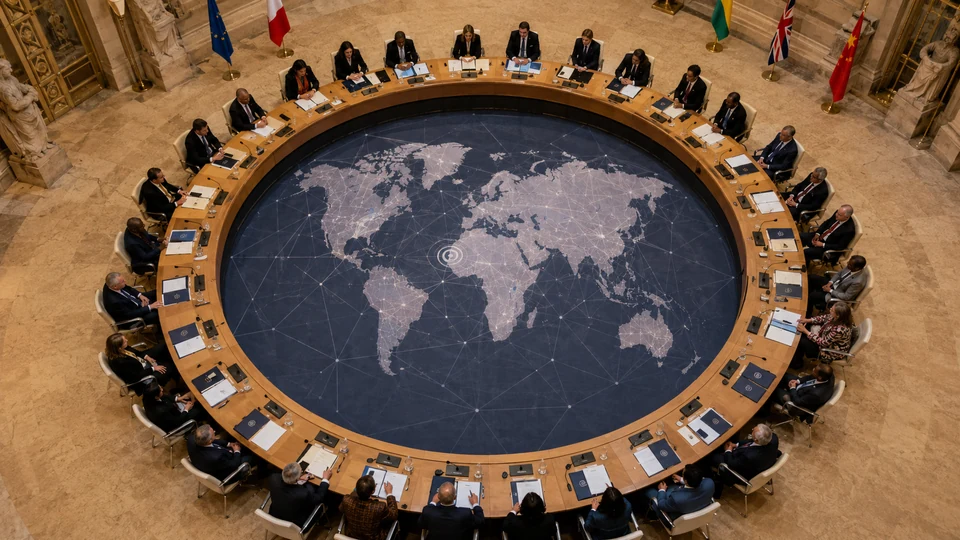 Conceptual visual
This is FUURAA’s own editorial analysis of the cited public source, prepared independently from the cited institution. Source materials remain attributable to their authors and publishers; FUURAA is responsible for their selection, synthesis and interpretation. No cited institution has reviewed or endorsed this article unless expressly stated.
External evidence
What the United Nations established
The UN General Assembly appointed 40 members to the Independent International Scientific Panel on AI in February 2026. The Panel launched its preliminary evidence report on 1 July, and the first Global Dialogue on AI Governance convened in Geneva on 6–7 July 2026.
The Panel provides evidence-based scientific assessments and is not a regulator: it does not set rules, enforce standards or prescribe policy. The Dialogue is a recurring multilateral forum, not a single binding global AI code.
FUURAA editorial analysis
FUURAA editorial perspective
Evidence-led analysis in the public interest
AI is developing across borders while laws, institutions, infrastructure and social priorities differ. Durable governance will require a shared evidence base without erasing legitimate regional differences.
Companies participating in this era should follow global scientific and policy developments, explain their relevance, and avoid presenting one institution’s position as universal consensus.
- The UN scientific panel and global dialogue create a recurring multilateral forum for evidence and governance discussion, not a single global regulator or binding AI code.
- Shared scientific understanding can improve cooperation only if uncertainty, regional diversity and unequal capacity remain visible.
- Companies should follow and explain global policy developments without presenting participation, citation or one institution’s position as universal endorsement.
A continuing forum is different from a world regulator
The UN General Assembly appointed 40 members to the Independent International Scientific Panel on AI in February 2026. The Panel launched its preliminary evidence report on 1 July, and the first Global Dialogue on AI Governance convened in Geneva on 6–7 July 2026. These developments turn the mechanisms established in 2025 into an active, recurring process for scientific assessment and multilateral discussion. Their scope must nevertheless be described precisely: the Panel is not a regulatory body, does not set rules or enforce standards, and the Dialogue does not automatically harmonise national law or create a single binding legal code.
Shared evidence should preserve uncertainty and difference
A common evidence layer can help policymakers compare technical developments and social effects, but scientific summaries do not eliminate legitimate disagreement. AI risks and benefits can vary with infrastructure, language, public services, legal systems and development priorities. Global discussion should make these contexts visible rather than treating the experience of highly resourced institutions as universal. It should also distinguish measured evidence from projections and policy preferences. FUURAA’s editorial inference is that useful international knowledge infrastructure must translate complex developments without flattening uncertainty or allowing accessibility to become oversimplification.
Participation must be wider than formal representation
Governments and recognised institutions are central to multilateral governance, yet affected people, researchers, civil society, workers and smaller firms can hold relevant knowledge that formal processes may miss. Inclusion should not be judged only by the number of participants; it also depends on whether information is accessible, contributions can shape the agenda and less-resourced communities can sustain participation. No global mechanism can fully resolve these imbalances, but transparent methods and public records can make limitations easier to examine. Regional and national institutions will still be required to convert dialogue into context-appropriate action.
Companies have duties when interpreting global policy
A company may legitimately analyse UN material and explain its relevance to technology, markets or governance. It should cite the original source, state where a conclusion is its own and avoid implying that the UN supports a product or strategy. Policy summaries also need dates and jurisdictional context because international discussions and domestic implementation do not move at the same pace. Responsible editorial work can help the public navigate complex institutions, provided it preserves the distinction between reporting, analysis, advocacy and corporate interest. That boundary is essential for FUURAA’s ambition to serve as a trusted knowledge hub.
Alternative views & uncertainty
What this evidence does not settle
- A global dialogue can improve coordination, but broad consensus processes may move more slowly than technical change or produce language too general for operational decisions.
- National and regional diversity deserves respect, yet excessive fragmentation can make cross-border systems harder to govern and leave important risks without effective cooperation.
Public-interest implications
What this means for different stakeholders
People need concise explanations of what international mechanisms do, what authority they lack and how global discussions may—or may not—affect local rights and services.
Companies should track international evidence and emerging expectations while maintaining jurisdiction-specific compliance and independent operational accountability.
Governments can use global dialogue for learning and coordination but must still translate evidence into lawful, resourced and locally legitimate implementation.
Researchers should examine representation, evidence quality, policy uptake and the effects of governance mechanisms rather than measuring participation alone.
What to watch next
- How the Panel’s preliminary report defines evidence quality, communicates uncertainty and develops its method before the next annual report.
- Whether the Global Dialogue enables sustained, influential participation from the Global South, less-resourced countries and affected communities.
- How governments and organisations absorb the Panel’s evidence without misrepresenting scientific assessment as binding global law.
The UN mechanisms mark a shift from episodic concern toward a permanent global conversation about AI. Their value will not come from pretending that one institution can govern every technology or society. It will come from improving shared understanding, revealing disagreement and helping jurisdictions learn from one another while retaining responsibility for implementation. FUURAA supports careful engagement with this process, coupled with exact language about authority, evidence and endorsement. A trustworthy global knowledge layer should make governance easier to understand without making it appear simpler than it is.
This is FUURAA’s independent editorial analysis of the cited United Nations material. It does not imply UN approval, participation, partnership or endorsement, and no FUURAA interpretation should be attributed to the United Nations.
Forward view
What a global knowledge layer can support
Shared evidence
Translate technical developments into material that policymakers and the public can scrutinise.
Jurisdictional context
Show where a rule or recommendation applies and where it does not.
Continual review
Update policy summaries as institutions, evidence and implementation timelines change.
Continue reading
Related insights

20 May 2026
From Singapore: Foundations for Responsible Agentic AI
Singapore’s updated governance framework combines risk boundaries, human accountability, technical controls and transparency with practical deployment cases.Read insight →
Implementation guidance current in 2026
Risk-Based AI Rules Are Becoming an Operating Reality
The European Union’s AI Act applies obligations according to risk and is being phased in across prohibited uses, general-purpose models, transparency and high-risk systems.Read insight →
3 February 2026