Technical mechanism
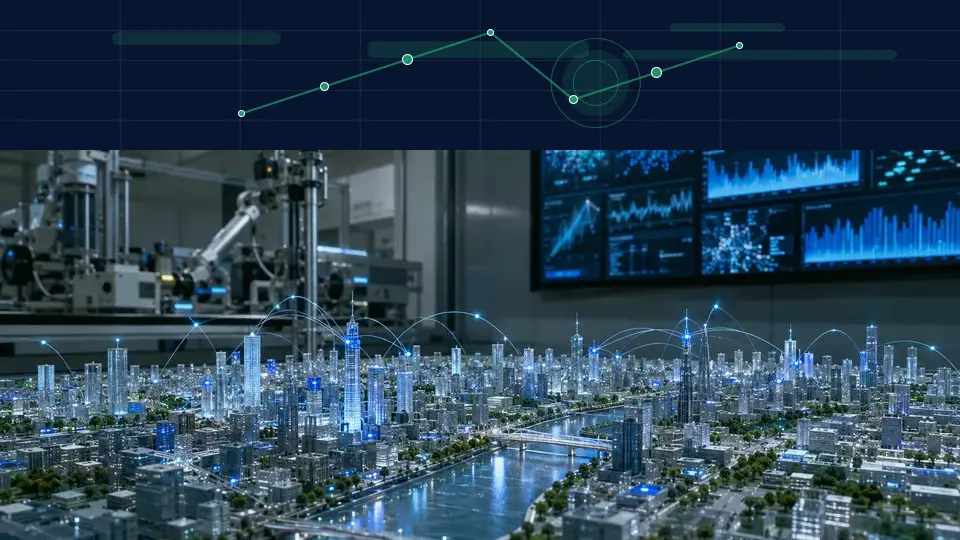
Digital twins fuse CAD or BIM, 3D reconstruction, IoT telemetry and physical simulation into a time-synchronised model of an asset or environment.

Technology topic profile
Definition & scope
On-device intelligence, sensor fusion and spatial models connect digital systems with buildings, cities, landscapes and the changing Earth.
FUURAA examines “Digital twins and 3D understanding” through its technical mechanism, deployment infrastructure, evidence requirements and public-interest consequences. This profile separates what can be demonstrated from what still requires field validation.
This is a technology and opportunity profile. It does not announce a current FUURAA product, ownership position, partnership, investment or transaction.
System map
Technical capability, enabling infrastructure, evidence and governance must be considered together.
Digital twins fuse CAD or BIM, 3D reconstruction, IoT telemetry and physical simulation into a time-synchronised model of an asset or environment.
Edge processors, sensor networks, positioning, maps, digital twins, communications and cloud coordination create a continuous physical-digital system.
A useful twin should demonstrate calibrated agreement with the physical system, bounded prediction error, timely updates and verified response to interventions.
Key risks are model divergence, false precision, stale telemetry, cyber-physical attack surfaces and interoperability failures between source systems. System-wide governance also requires: Persistent sensing raises questions about consent, surveillance, data sovereignty, environmental representation and who may act on spatial inferences.
Application contexts
Examine how “Digital twins and 3D understanding” could create measurable value in “Smart environments”, which supporting systems are required and where human responsibility must remain explicit.
Application contextExamine how “Digital twins and 3D understanding” could create measurable value in “Field operations”, which supporting systems are required and where human responsibility must remain explicit.
Application contextExamine how “Digital twins and 3D understanding” could create measurable value in “Earth observation”, which supporting systems are required and where human responsibility must remain explicit.
Selected evidence record
FUURAA summarises and analyses; original institutions retain ownership of their work and have not reviewed or endorsed this page.
FUURAA has not attached a source that only appears related through broad AI terminology. This profile remains an editorial technology overview until a direct, attributable source is added.
Diligence questions
A credible technology profile should make it easier to identify evidence, dependencies, boundaries and unanswered questions.
What evidence would distinguish a controlled demonstration of “Digital twins and 3D understanding” from dependable operation?
Which technical dependency or operational bottleneck most constrains performance at scale?
Which failure or harm described in this profile should trigger suspension, escalation or human review?
Which cost, performance, safety or interoperability result would invalidate the current adoption thesis?
FUURAA outlook
Spatial intelligence may become an operating layer for buildings, mobility, field work and Earth systems as local models and sensor networks improve. For “Digital twins and 3D understanding”, credible progress should therefore be judged by verified outcomes, system resilience, responsible adoption and the ability to correct course—not by novelty alone.
This outlook is an editorial assessment, not a market forecast, investment recommendation or product timetable.What We Build